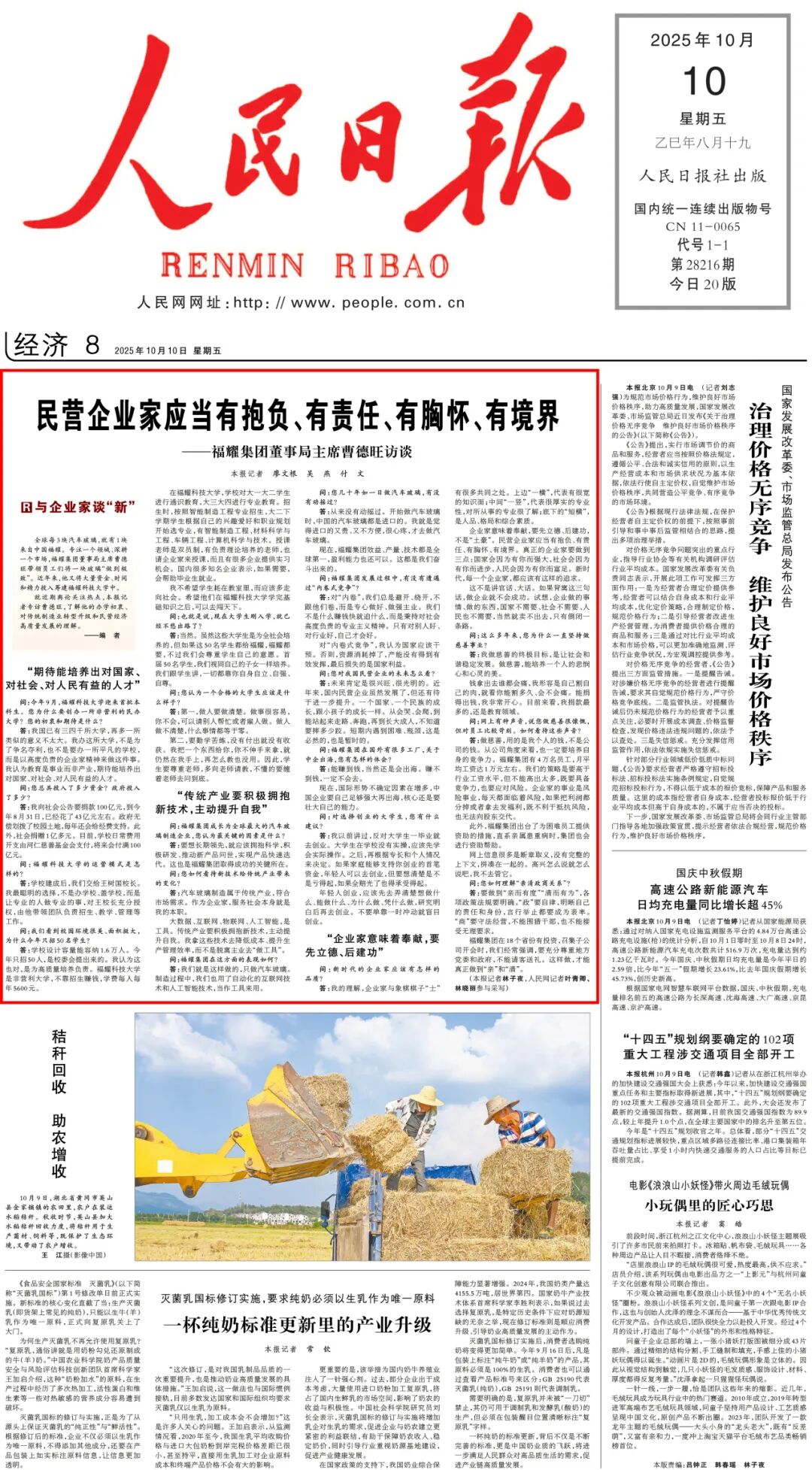
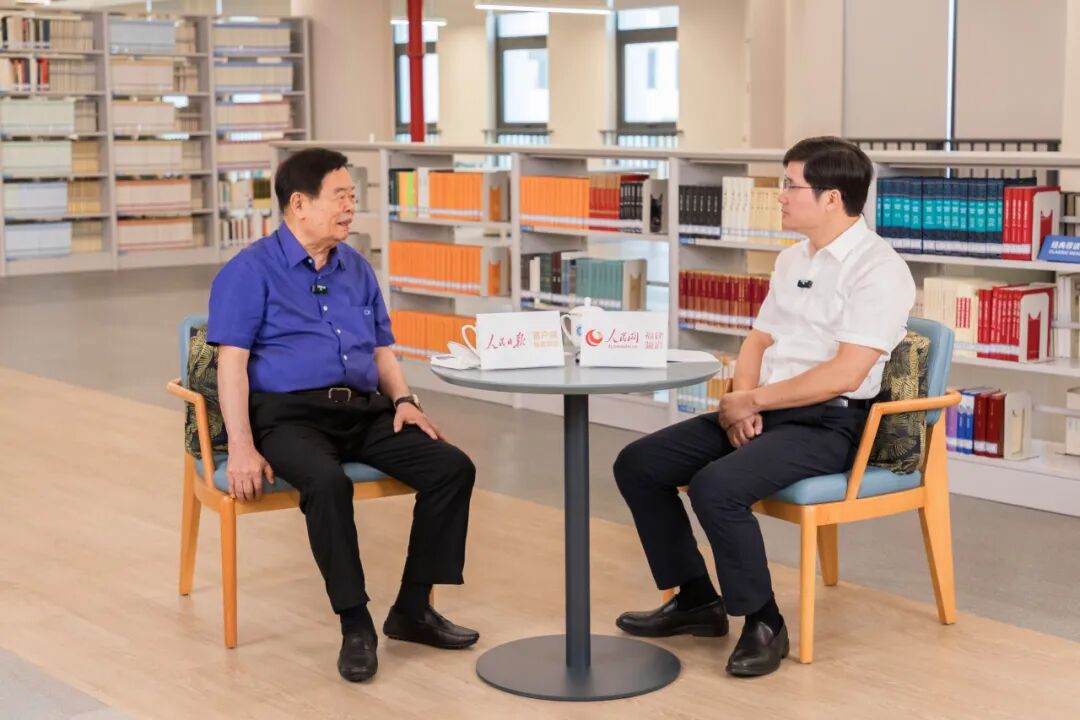
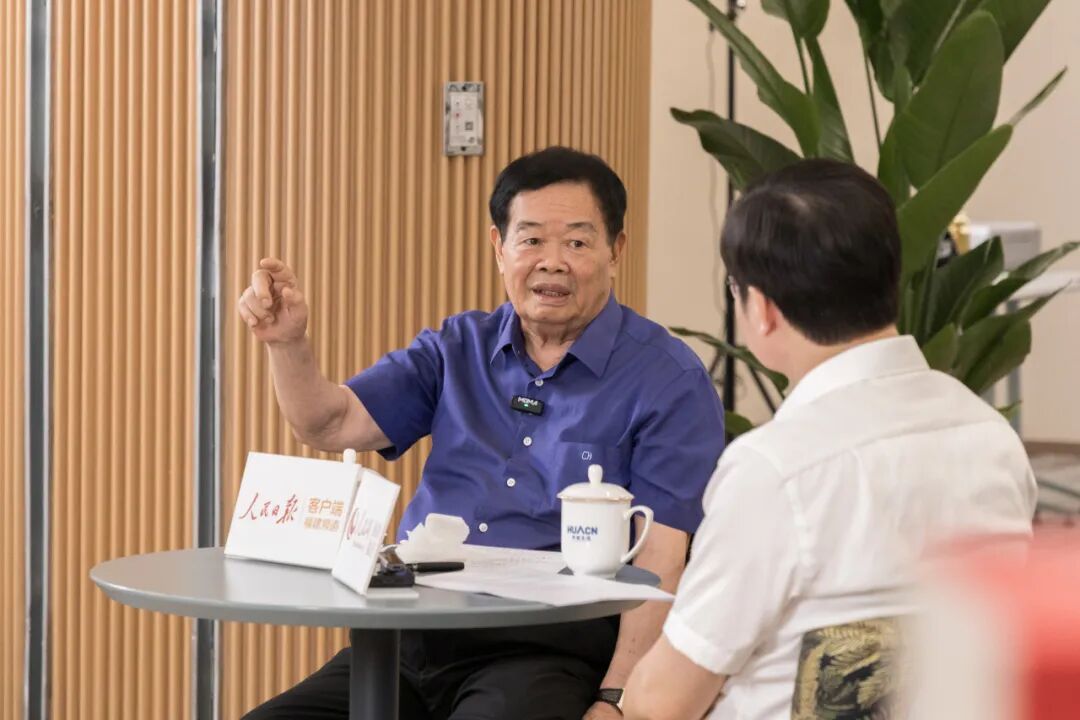
On October 10, People’s Daily published an exclusive interview with Cao Dewang, Chairman of Fuyao Group, titled “Private Entrepreneurs Should Embrace Aspiration, Responsibility, Vision and Integrity.” In the in-depth conversation, Cao shared his insights and experiences on founding Fuyao University of Science and Technology, advancing traditional manufacturing transformation, and fulfilling the mission of private entrepreneurs.
Focusing on One Field, Perfecting One Product
One out of every three pieces of automotive glass worldwide is made by Fuyao. For decades, Cao has led his team to perfect a single product: glass. In recent years, he has also invested substantial capital, time and energy into establishing Fuyao University of Science and Technology, embodying the commitment of private enterprises to stay focused on core businesses and give back to society.
In this exclusive interview, Cao discussed his vision for the university, his views on traditional manufacturing upgrading, and his outlook for high-quality development of the private sector.
“I Hope to Nurture Talents
Who Serve the Nation, Society and People ”
Q: Fuyao University of Science and Technology welcomed its first undergraduate cohort this September. Why establish a non-profit private university? What are your original aspirations and expectations?
A: China already has over 3,000 universities. Adding another ordinary one makes little sense. I am not doing this for fame or profit. I approach it with responsible entrepreneurship. Education is a public cause, not an industry. I aim to nurture talents who contribute to the nation, society and people.
Q: How much have you invested? Has the government provided funding?
A: I pledged 10 billion RMB in donations. As of August 31, approximately 4.3 billion RMB has been spent. The government provided free land and annual operational subsidies. Social donations exceed 100 million RMB. Daily operations are funded by the He Ren Charitable Foundation, which will fulfill the full 10 billion commitment over time.
Q: What is the university’s operational model?
A: After completion, the university is led by President Wang Shuguo. My wisest decision is to let professionals run the institution. I fully empower the president and his team to oversee admissions, teaching and management.
Q: The campus is large and beautiful. Why only admit 50 students this year?
A: The campus can accommodate up to 16,000 students. The enrollment of 50 was proposed by the university council. It reflects our commitment to high-quality education. As a non-profit university, we do not rely on tuition fees. Annual tuition is 5,600 RMB per student.
The curriculum combines general education (freshman and sophomore years) and specialized education (junior and senior years). Students are initially admitted to Intelligent Manufacturing Engineering, then choose majors in their second year: Intelligent Manufacturing Engineering, Materials Science and Engineering, Vehicle Engineering, and Computer Science and Technology.
Teaching adopts a dual-faculty model: academic instructors and industry practitioners. Many enterprises offer internships, and leading Chinese companies have committed to supporting graduate employment.
I encourage students to step out of classrooms and into society. After acquiring foundational knowledge, I hope they venture into the world.
Q: So graduates already have clear career paths?
A: Absolutely. While we educate for society at large, Fuyao would hire all 50 students if they wished. We respect their choices. We treat the first cohort like our own children, teaching them to be self-reliant, resilient and respectful.
Q: What defines a qualified university graduate?
A: First, integrity in character. Work can be delegated; character cannot. Second, diligence and perseverance. No effort, no gain. Students must respect teachers, seek guidance proactively, and pursue answers rigorously.
“Traditional Industries Must Embrace New Technologies
and Upgrade Proactively”
Q: Fuyao is the world’s largest automotive glass manufacturer. What is the key to your long-term success?
A: To sustain leadership, we must embrace science, invest in R&D, and accelerate product innovation. This is Fuyao’s core strength.
Q: How do you view the impact of new technologies on traditional industries?
A: Automotive glass manufacturing is traditional yet essential. As entrepreneurs, serving society is our duty.
Big data, the internet, IoT and AI are tools. Traditional industries must adopt them to reduce costs and improve efficiency, not to abandon core businesses.
Q: How has Fuyao implemented this?
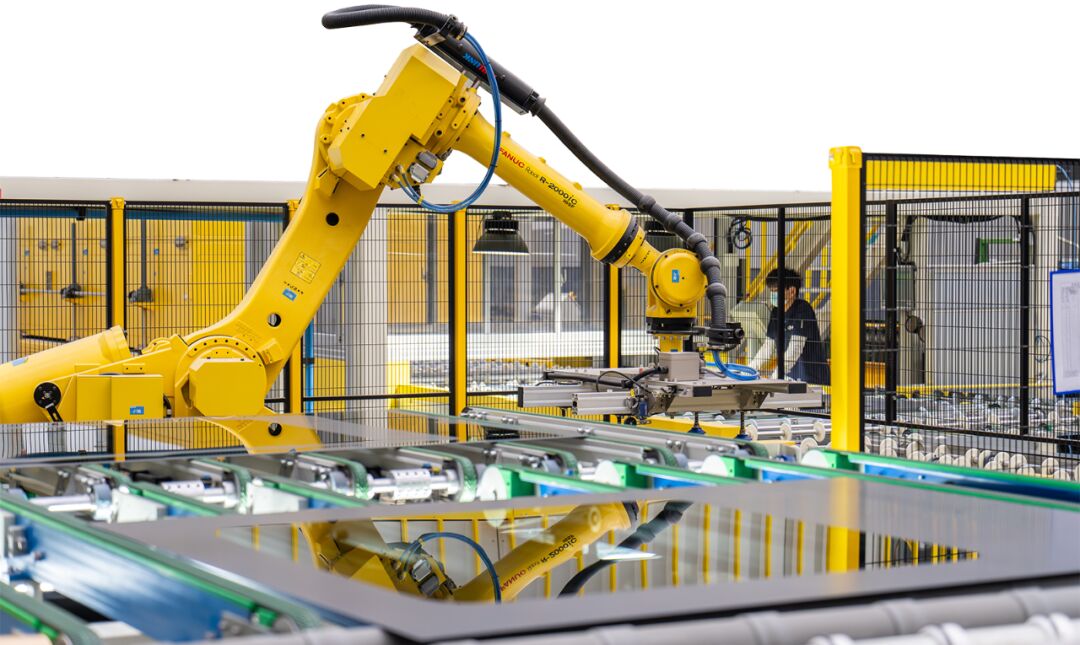
A: We remain focused on automotive glass. We leverage automation, internet and AI as tools in production.
Q: Decades in one industry—have you ever wavered?
A: Never. When I started, all automotive glass in China was imported. It was expensive and inconvenient. That motivated me.
Today, Fuyao leads globally in scale, technology and profitability. Our success comes from relentless effort.
Q: Has Fuyao faced “involution-style competition”?
A: We avoid it. We focus on strengthening our core business, not chasing quick profits. We uphold professionalism and social responsibility. When you benefit others and the industry, you benefit yourself.
I believe the state should curb excessive competition. It wastes resources, underutilizes capacity, and harms national interests.
Q: What is your outlook for China’s private enterprises?
A: The future is bright and promising. While progress has been made, further improvement is needed. Growth involves setbacks—challenges are temporary.
Q: Fuyao operates overseas. What are your views on Chinese companies going global?
A: Expand if profitable; otherwise, do not. With rising global uncertainty, Chinese enterprises must strengthen core capabilities before going abroad.
Q: Advice for college graduates considering entrepreneurship?
A: I discourage immediate post-graduation entrepreneurship. Students need practical experience first. If family support is available, young people may start businesses—but they must assess risks and accept losses.
Clarify your goals, capabilities, motivations and competitive advantages before starting. Avoid impulsive decisions.
Q: What qualities define entrepreneurs in the new era?
A: An entrepreneur resembles the Chinese chess piece “Shi” (advisor): broad knowledge, deep expertise, and strong character.
Entrepreneurship means dedication: cultivate virtue first, then pursue achievements. Private entrepreneurs need aspiration, responsibility, vision and integrity. True entrepreneurs achieve three things: strengthen the nation, advance society, and enrich people’s lives.
This is not empty talk. Businesses fail if they produce what no one needs.
Q: Why have you long supported philanthropy?
A: Philanthropy fosters social harmony, compassion and kindness. Giving is painful but rewarding. My largest donations go to education.
Q: Some criticize you for being generous in charity but strict with employees. Your response?
A: Philanthropy uses personal funds, not corporate resources. Fuyao must maintain competitiveness. Our average monthly salary is ~10,000 RMB, above industry standards. Balancing competitiveness and risk resilience is essential.
We also provide financial aid for employees in need and medical support for seriously ill family members. Online comments are often taken out of context—I pay them no mind.
Q: How do you view a “close and clean” government-business relationship?
A: It means closeness with boundaries, integrity with action. Governments must uphold discipline; enterprises must operate legally.
Fuyao invests in 18 provinces. We emphasize respect for local authorities and reject gifts or banquets. This achieves both closeness and integrity.